

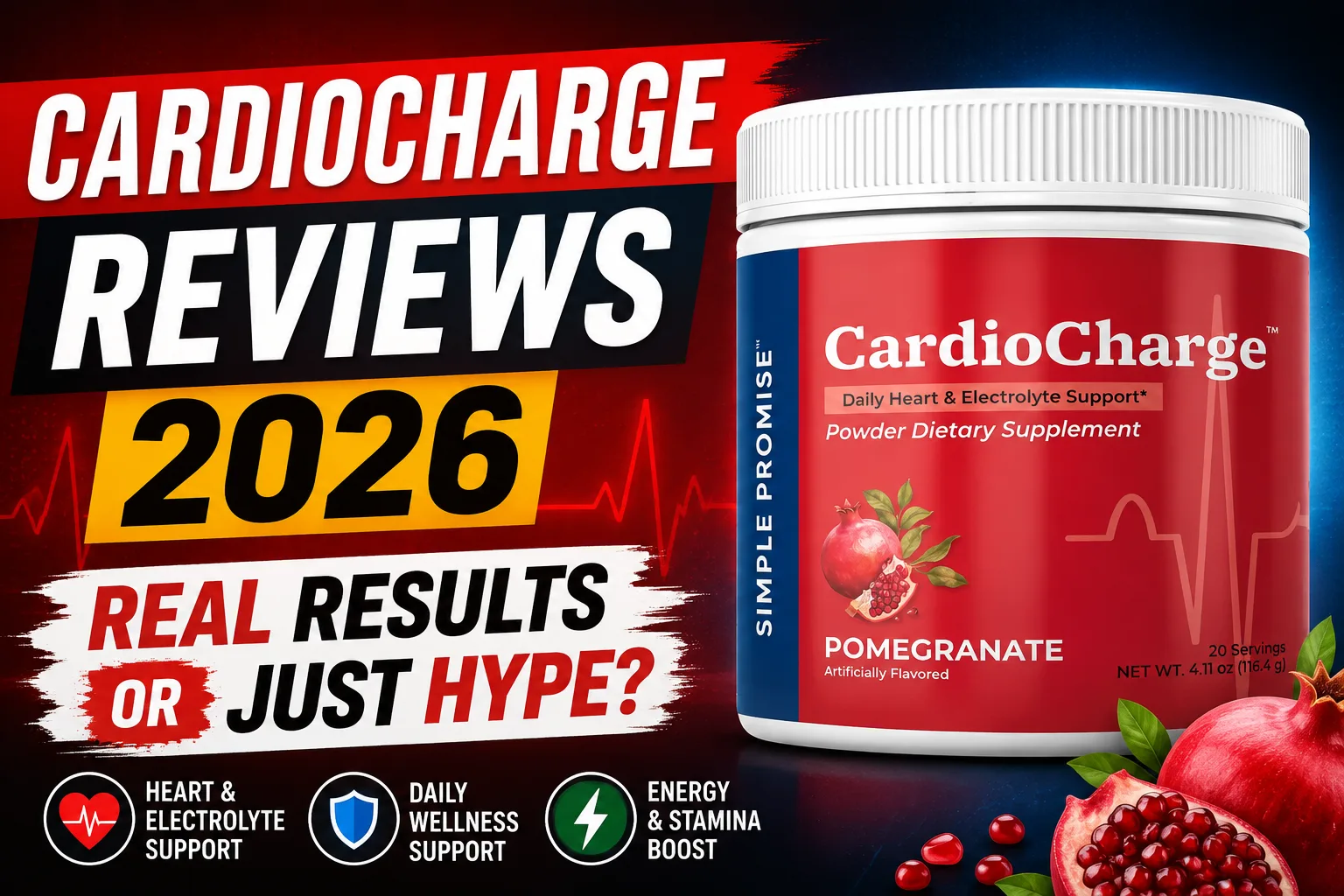
If you have been searching for CardioCharge reviews, you have probably seen claims about heart support, circulation, electrolytes, and daily energy. But does CardioCharge really live up to the attention it is getting?
In this Cardio Charge review for 2026, we look at what the product is, its ingredients, potential benefits, limitations, safety considerations, and what U.S. consumers should know before buying.
The goal is simple: separate the manufacturer’s claims from what can actually be supported by available evidence.
Quick Verdict: CardioCharge is a powdered drink mix marketed for daily heart and circulation support. Its formula contains seven ingredients, including magnesium, potassium, D-ribose, glycine, hibiscus, sodium citrate, and olive extract. However, it should be viewed as a dietary supplement rather than a treatment for heart disease, high blood pressure, or other medical conditions.
What Is CardioCharge?
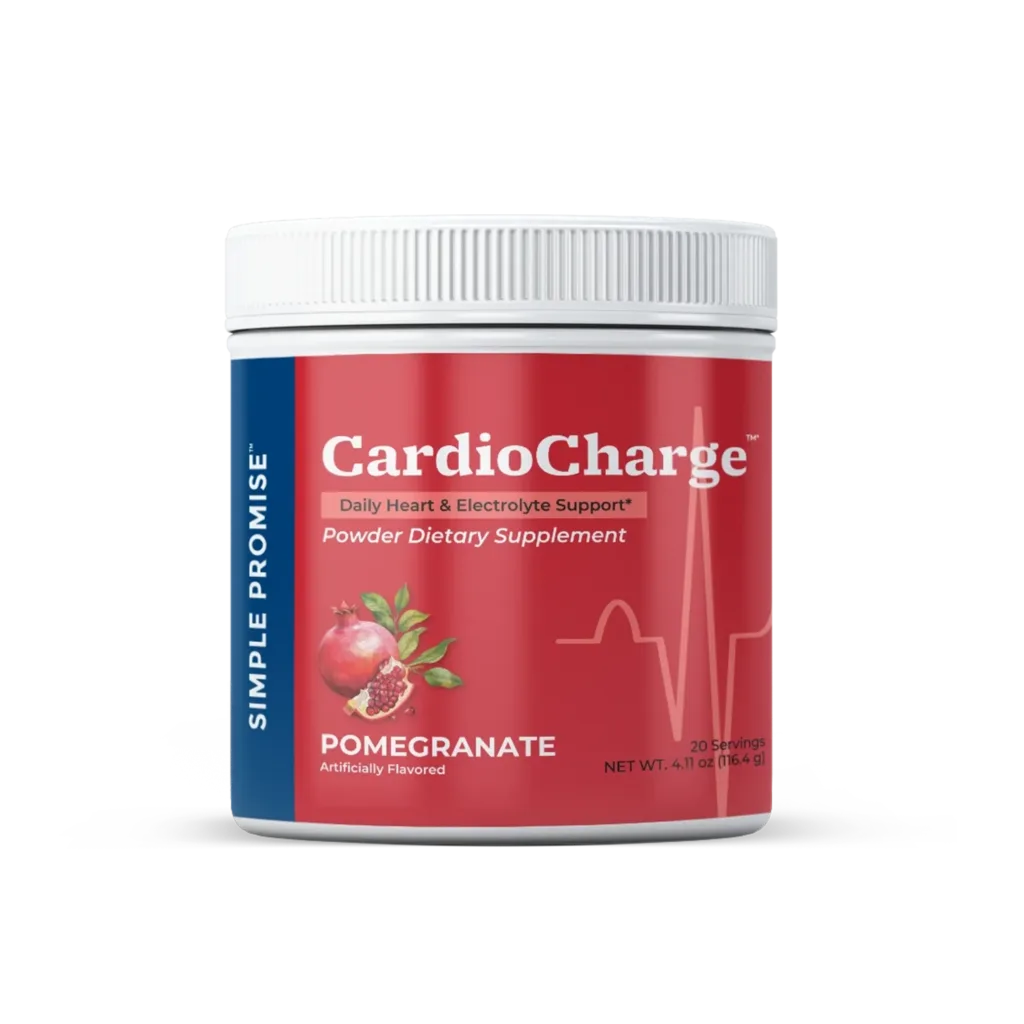
Cardio Charge is a daily powdered drink mix from Simple Promise. According to the product’s official website, it is designed to be mixed with water and taken once daily.
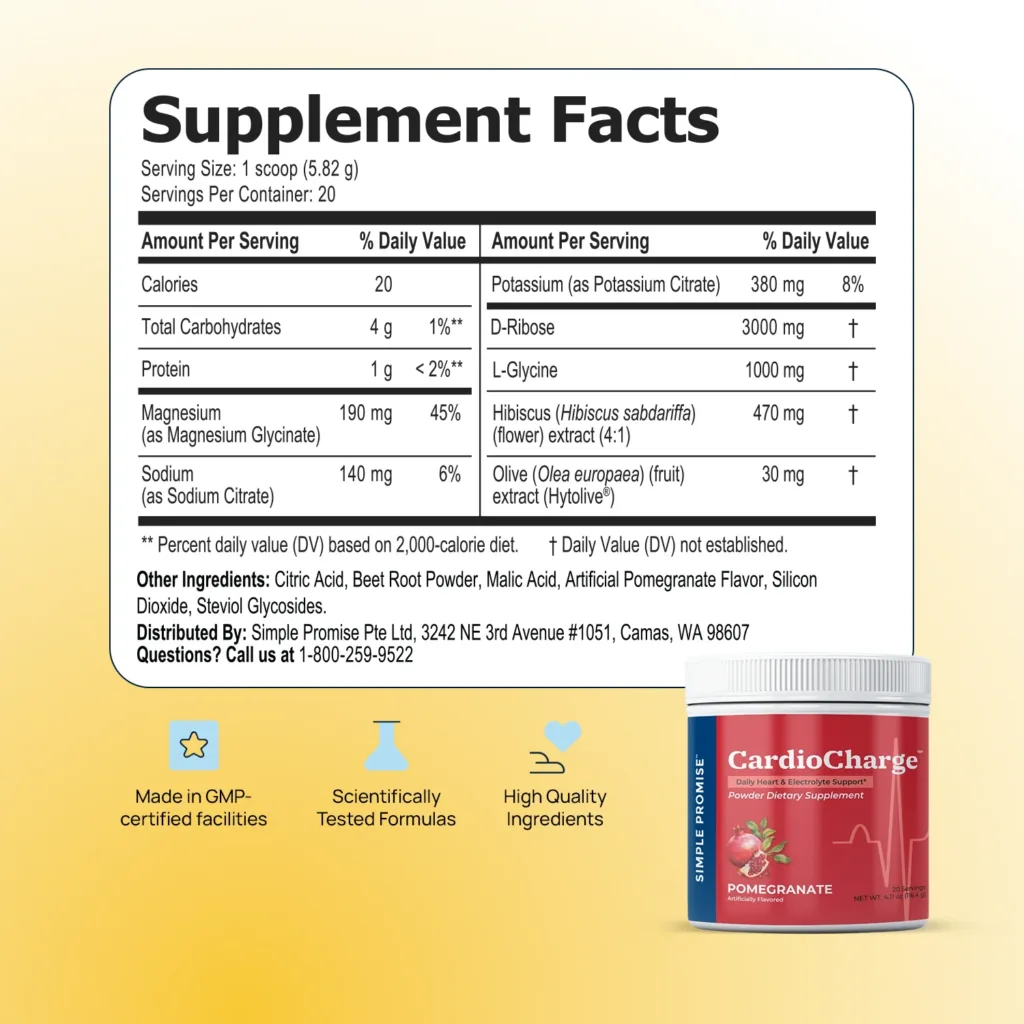
The current product information lists seven active ingredients:
- Magnesium glycinate
- Potassium citrate
- Sodium citrate
- D-ribose
- L-glycine
- Hibiscus extract
- Hytolive olive extract
The manufacturer positions CardioCharge around everyday heart, circulation, electrolyte, and energy support.
That positioning is important to understand.
Cardio Charge is a dietary supplement, not an FDA-approved medication.
The FDA explains that it does not approve dietary supplements before they are marketed for safety or effectiveness in the same way it approves drugs. Manufacturers remain responsible for complying with applicable safety and labeling requirements.
CardioCharge Ingredients
One of the most important parts of any supplement review is looking beyond the marketing language and examining what is actually in the formula.
1. Magnesium
Magnesium is an essential mineral involved in numerous processes in the body.
Because CardioCharge contains magnesium glycinate, it provides magnesium as part of its daily formula.
However, consumers should not assume that taking a magnesium-containing supplement will automatically improve cardiovascular health. The effect depends on factors such as dietary intake, individual nutritional status, dosage, and overall health.
2. Potassium
Potassium is another essential mineral and plays an important role in normal muscle and nerve function.
Potassium is also relevant to blood-pressure regulation. However, taking additional potassium is not appropriate for everyone.
People with certain kidney conditions or people taking medications that affect potassium levels should speak with a healthcare professional before using potassium-containing supplements.
3. Sodium Citrate
Sodium citrate provides sodium and is included as part of the electrolyte-oriented formula.
This is worth considering if you are specifically trying to reduce sodium intake because of a healthcare provider’s recommendation.
A supplement marketed for heart wellness is not automatically appropriate for every heart-health goal.
4. D-Ribose
D-ribose is a naturally occurring sugar involved in the body’s energy-related processes.
Cardio Charge includes D-ribose as one of its seven ingredients.
However, the presence of an ingredient in a supplement does not by itself prove that the finished product will produce a particular health outcome.
5. L-Glycine
Glycine is an amino acid used by the body for several biological functions.
CardioCharge includes L-glycine as part of its formula.
As with the other ingredients, it is important to distinguish between research on an individual ingredient and clinical evidence specifically demonstrating that the finished CardioCharge product produces a particular benefit.
6. Hibiscus Extract
Hibiscus is one of the more interesting ingredients in the formula.
The National Center for Complementary and Integrative Health (NCCIH) notes that some research has investigated hibiscus for blood-pressure effects. However, the evidence is limited, and dietary supplements have not been shown to produce effects comparable to medications used to treat hypertension.
That means it would be inappropriate to describe Cardio Charge as a treatment for high blood pressure based solely on its inclusion of hibiscus.
7. Hytolive Olive Extract
CardioCharge also contains Hytolive, a patented olive extract.
The manufacturer includes this ingredient as part of its heart-and-circulation formula.
However, research involving an individual ingredient should not automatically be interpreted as proof that the complete Cardio Charge formulation has been clinically proven to produce the same effects.
What Are the Potential Cardio Charge Benefits?
Based on its formulation and marketing, Cardio Charge is intended to provide several types of everyday support.
Daily Electrolyte Support
Magnesium, potassium, and sodium are electrolytes involved in normal body functions.
This makes the product relevant to consumers looking for a convenient powdered drink containing several electrolytes.
Heart and Circulation Support
The manufacturer specifically markets CardioCharge for heart and circulation support.
However, consumers should be careful with the wording.
“Supports heart health” is not the same as “treats heart disease.”
The latter would be a medical treatment claim and requires a much higher level of evidence.
Energy Support
D-ribose is included in the formula and is associated with cellular energy metabolism.
Still, there is a difference between having an ingredient involved in energy-related biological processes and proving that a finished supplement meaningfully increases energy in consumers.
Does Cardio Charge Lower Blood Pressure?
This is one of the most important questions surrounding CardioCharge.
The honest answer is: you should not treat Cardio Charge as a blood-pressure medication.
NCCIH states that evidence surrounding dietary supplements and blood pressure is generally limited, and no dietary supplement has demonstrated effects comparable to medications used to treat hypertension.
Hibiscus, one of Cardio charge’s ingredients, has been studied for blood pressure, but that does not establish CardioCharge itself as an effective treatment.
If you have hypertension, continue following the treatment plan provided by your healthcare professional.
CardioCharge Reviews: What About Real Results?
This is where many online supplement reviews become misleading.
A customer may report feeling better after using a supplement. That experience can be genuine, but it does not establish that the supplement caused the result.
The FTC explains that health-related advertising claims should be supported by competent and reliable scientific evidence. It also warns that individual testimonials are not a substitute for appropriate scientific research.
Therefore, when evaluating CardioCharge reviews, look for:
- Transparent ingredient information
- Clearly stated serving information
- Evidence relating to the actual product
- Independent research where available
- Realistic claims
- Appropriate safety information
- Clear information about the manufacturer
Be skeptical of reviews promising dramatic changes in blood pressure, cholesterol, circulation, or heart disease.
Order CardioCharge Today – Official Website & Special Deal
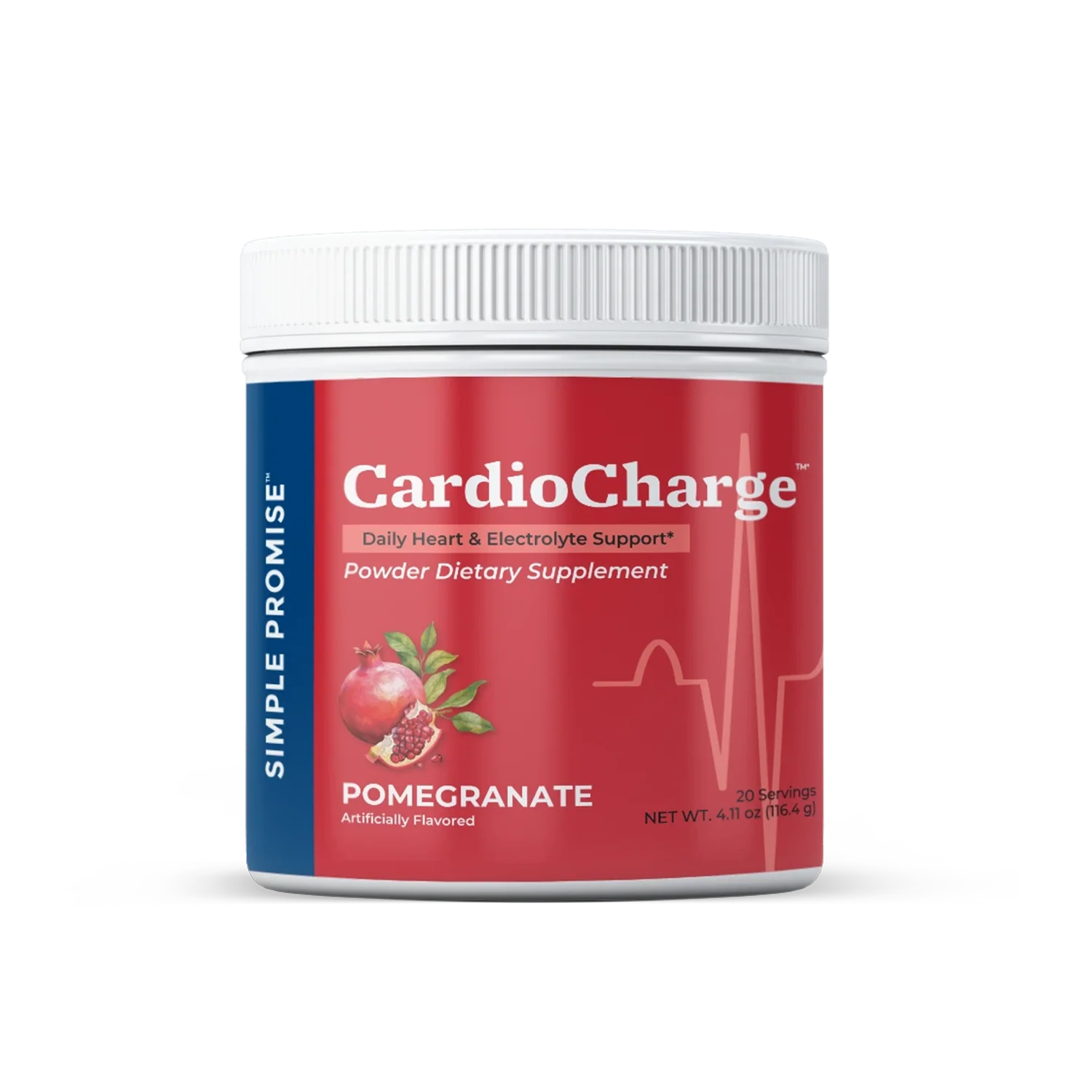
Is CardioCharge FDA Approved?
No.
It is important to understand what this statement means.
The FDA explains that dietary supplements are not generally approved before marketing for safety and effectiveness in the same way drugs are. The manufacturer is responsible for ensuring that its supplement meets applicable requirements.
Therefore, you should not interpret the availability of CardioCharge in the United States as evidence that the FDA has approved it to prevent, treat, or cure heart disease.
This distinction is important when reading online advertisements and reviews.
CardioCharge Safety: What Should You Know?
“Natural” or “dietary supplement” does not automatically mean risk-free.
Your personal health situation matters.
You should speak with a healthcare professional before taking CardioCharge if you:
- Have kidney disease
- Have cardiovascular disease
- Have high or low blood pressure
- Take prescription medications
- Take medication that affects potassium levels
- Are pregnant or breastfeeding
- Have been instructed to restrict sodium or potassium
This is particularly important with supplements containing electrolytes such as potassium and sodium.
If you take prescription medication, ask your doctor or pharmacist whether the ingredients are appropriate for you.
CardioCharge Pros and Cons
Pros
- Powdered drink format
- Seven active ingredients
- Contains magnesium and potassium
- Includes hibiscus extract
- Caffeine-free positioning
- Convenient once-daily format
- Designed for consumers interested in cardiovascular and electrolyte support
Cons
- Not an FDA-approved treatment
- Evidence for the complete formula may not establish specific medical benefits
- Should not replace prescribed cardiovascular medication
- People with certain medical conditions may need professional guidance
- Online marketing claims should be evaluated carefully
CardioCharge vs. Heart-Healthy Lifestyle
This is an important point that is sometimes overlooked in supplement reviews.
A supplement should not become the centerpiece of a heart-health strategy.
NCCIH notes that lifestyle measures and appropriate medical treatment remain important for cardiovascular risk factors. Dietary supplements may have relatively small effects on some risk factors and should not automatically replace established treatments.
For many people, the bigger picture includes:
- Regular physical activity
- A balanced eating pattern
- Maintaining a healthy weight
- Avoiding tobacco
- Getting adequate sleep
- Managing stress
- Monitoring blood pressure
- Monitoring cholesterol when appropriate
- Following prescribed medications
CardioCharge, if used, should be considered as part of that broader approach rather than a replacement for it.
Is CardioCharge Worth It?
Whether CardioCharge is worth trying depends on what you expect from it.
If you are looking for a convenient powdered supplement containing electrolytes and several ingredients associated with general wellness, the formula may be interesting.
However, if you are looking for a product that will treat high blood pressure, reverse heart disease, lower cholesterol dramatically, or replace prescription medication, CardioCharge should not be viewed that way.
The available evidence does not justify making those kinds of claims.
The FTC specifically emphasizes that health-product claims should be supported by appropriate scientific evidence and should not exaggerate what the research demonstrates.
Final CardioCharge Review 2026: Real Results or Just Hype?
So, are the claims about CardioCharge real results or just hype?
The answer is somewhere in the middle.
CardioCharge has a clearly identified seven-ingredient formula and is positioned as a daily drink for heart, circulation, electrolyte, and energy support.
Some individual ingredients have scientific research behind them. For example, hibiscus has been studied for potential blood-pressure effects, although NCCIH describes the evidence as limited and does not consider supplements comparable to hypertension medications.
What should concern consumers is not necessarily the ingredient list itself, but overstated expectations.
CardioCharge should not be considered a cure or treatment for cardiovascular disease. And because dietary supplements are not FDA-approved for effectiveness before being marketed, consumers should carefully distinguish between manufacturer marketing, ingredient research, customer testimonials, and evidence from clinical studies.
Our Take
CardioCharge may be worth considering as a dietary supplement for adults interested in a convenient heart-and-electrolyte wellness drink, but it should not replace medical care or prescribed treatment.
If you have a cardiovascular condition or take medication, speak with your healthcare professional before adding it to your routine.
Frequently Asked Questions
What is CardioCharge?
CardioCharge is a powdered dietary supplement marketed as a daily drink for heart, circulation, electrolyte, and energy support. Its current formula lists seven active ingredients.
Does CardioCharge really work?
CardioCharge is a powdered dietary supplement marketed as a daily drink for heart, circulation, electrolyte, and energy support. Its current formula lists seven active ingredients.
Can CardioCharge treat high blood pressure?
CardioCharge should not be used as a treatment for high blood pressure. NCCIH states that evidence for dietary supplements and blood pressure is limited and that supplements have not demonstrated effects comparable to hypertension medications.
Is CardioCharge FDA approved?
No. FDA generally does not approve dietary supplements before they are marketed for safety and effectiveness.
Can I take CardioCharge with medication?
Do not assume that a supplement is compatible with your medication. Ask your doctor or pharmacist before using CardioCharge if you take prescription medication or have an existing medical condition.
Is CardioCharge a replacement for heart medication?
No. A dietary supplement should not be used as a substitute for medication prescribed by a healthcare professional.
What are the main CardioCharge ingredients?
The current product information lists magnesium glycinate, potassium citrate, sodium citrate, D-ribose, L-glycine, hibiscus extract, and Hytolive olive extract.
Medical & Advertising Disclaimer
This article is for educational and informational purposes only. It is not medical advice and does not diagnose, treat, cure, or prevent any disease.
Dietary supplements are not FDA-approved for safety or effectiveness before marketing in the same manner as drugs. Product claims should be evaluated carefully, and consumers should consult a qualified healthcare professional regarding medical conditions, medications, or potential supplement interactions.
Sources: U.S. Food and Drug Administration (FDA), Federal Trade Commission (FTC), and National Center for Complementary and Integrative Health (NCCIH).
Read more health supplement article


